I am burnout… but can I actually call in sick for that?!
You’re not “flu sick.” You’re not lying in bed with a fever or clearly unable to move. From the outside, things might even look relatively normal. You’re still showing up, still responding, still getting things done; at least to some extent.
But internally, it feels very different. Your energy is gone before the day even properly starts, your focus is slipping, and the job that once gave you satisfaction now mostly drains you. Even simple tasks feel heavier than they should, and your body is starting to send signals you can’t really ignore anymore.
And somewhere in the middle of all that, a question starts to linger in the background:
👉 “Does this even count as being sick?”
Can you report sick with a burnout?
Short answer: yes, you can.
In the Netherlands, sick leave is not limited to physical conditions. The legal framework doesn’t draw a hard line between “visible” illness and mental health struggles. If your health, physical or psychological, prevents you from properly performing your job, that is considered a valid reason to report sick.
Burnout falls within that scope. It often shows up as a combination of mental and physical complaints that, over time, make it increasingly difficult to function in a sustainable way. That might look like ongoing exhaustion, trouble concentrating, emotional detachment from your work, or even physical symptoms like tension, headaches, or a constant feeling of being unwell.
So even if you’re technically still able to push through parts of your day, the key question is not whether you can keep going for a bit longer, but whether you can do your job in a healthy and sustainable way. If the answer to that is no, then calling in sick is not only allowed… it’s appropriate.
Why it still feels like you’re “not allowed”

Despite this, many people hesitate. And that hesitation rarely comes from the law. It comes from how burnout actually feels in practice.
Unlike a broken leg or a high fever, burnout doesn’t give you a clear, undeniable stopping point. There’s often a grey area where you’re still functioning, just not well. That makes it easy to minimize what’s going on, or to convince yourself that it’s “not bad enough yet.”
At the same time, there’s usually a strong sense of responsibility, especially in roles where a lot depends on you. You’re aware of everything that still needs to happen, everything that’s unfinished, and everyone who might be affected if you suddenly step away.
That’s when thoughts like these start to take over:
- “Let me just fix a few things first”
- “I can’t leave the team like this”
- “What happens if I step away now?”
On paper, reporting sick is straightforward. In reality, it can feel like you’re about to drop everything and everyone at once.
The responsibility trap
In situations like this, that feeling is even stronger because you haven’t just been doing your job; you’ve been carrying a significant part of the business on your shoulders for quite some time.
For example, building something from the ground up, dealing with structural understaffing, taking on responsibilities far beyond your role, and doing it all with limited support creates a situation where you become the central point holding everything together. Over time, that stops feeling like “extra effort” and starts feeling like something the entire operation depends on.
So when you reach the point where you can’t continue, the concern isn’t just about your own health anymore. It quickly shifts to questions like:
- Who is going to train the new hires?
- Who will handle the operational and administrative side?
- Is it fair to leave this to someone less experienced?
Those are valid concerns, but they also create a trap. Because if you wait until everything is perfectly arranged before allowing yourself to step back, that moment often never comes.
What is actually expected from you
From a legal perspective, the expectations during illness are much more limited and much clearer than people often think.
When you report sick, your primary responsibility is to focus on your recovery. That doesn’t mean disappearing completely, but it does mean that your role shifts. You are no longer responsible for keeping the business running or solving structural issues.
In practical terms, you are expected to:
- Report your sickness in a timely manner
- Remain reasonably reachable for communication
- Cooperate with guidance, for example from a bedrijfsarts if one becomes involved. See the other blogposts about this topic here.
What you are not expected to do is just as important. You are not required to push through exhaustion to complete handovers, to fix ongoing staffing problems, or to make sure everything is perfectly in place before you step away.
If you still have the capacity to transfer some knowledge or briefly explain ongoing matters, that can of course help. But if you’re dealing with burnout, your capacity is exactly the issue and that limit is something you’re allowed to respect.
“But I have an important position within the company…”
It’s very common for people in managerial or high demanding roles to feel like different rules apply to them. The level of responsibility is higher, the overview is broader, and the impact of stepping away can feel much bigger.
But legally, your position doesn’t change your rights.
You are still an employee, and you are still entitled to sick leave if your health requires it. There is no separate standard that says that, for example, managers or nurses, have to ensure continuity before they are “allowed” to be ill. That expectation might exist culturally or internally, but it doesn’t override your right to recover.
What happens after you call in sick
Part of the hesitation often comes from uncertainty about what will happen next. There’s a tendency to imagine everything coming to a standstill, or to assume that all unresolved issues will remain your responsibility.
In practice, once you report sick, the responsibility for continuity shifts back to the employer. They are the ones who need to assess the situation, redistribute work, arrange temporary solutions, or bring in additional support if needed.
If your absence continues, a bedrijfsarts may become involved to assess your situation and guide the recovery and reintegration process. That involvement is not meant as a form of control, but as a structured way to ensure that both your health and your return to work are handled properly.
The mistake that makes burnout worse
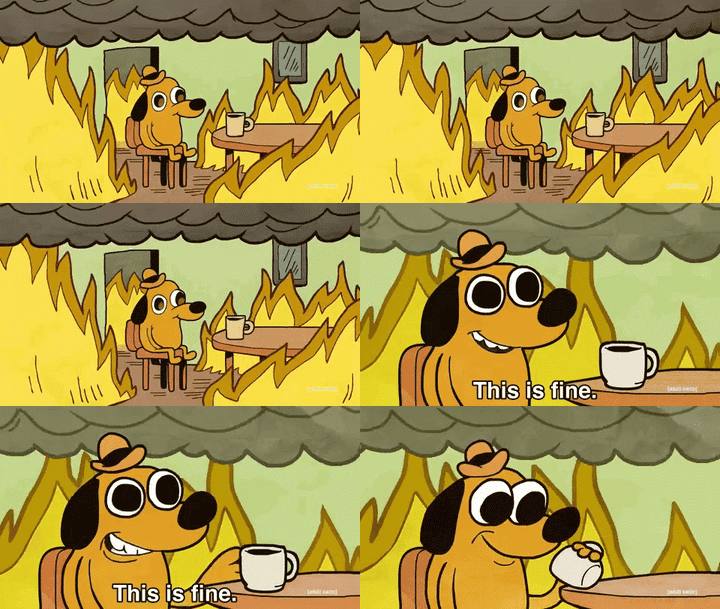
What often prolongs burnout situations is not the illness itself, but the delay in acknowledging it.
People tend to keep going longer than they should, telling themselves that they just need to get through a few more weeks, finish a few more things, or wait until the situation becomes more stable. But in environments where the workload and pressure are structural, that stability rarely arrives on its own.
Instead, the strain continues to build in the background until the body forces a stop. And by that point, recovery is usually more complex and takes significantly longer than it would have if there had been an earlier pause.
Final thought
Burnout doesn’t always look dramatic from the outside. There’s no clear moment where everything suddenly breaks. It’s usually a gradual process where functioning becomes harder and harder over time.
But the impact is real, and the system in the Netherlands is built on the idea that recovery should come first. Not as a last resort, but as a necessary step to prevent things from getting worse.
If you’re at a point where continuing feels unsustainable, the question isn’t whether you’re “allowed” to call in sick.
👉 It’s how long you can realistically keep going like this!
 The Case Clarity - by Kirsten Freichmann
Plaats een reactie